Saturday, March 04, 2006

witchcraft and religion

Religion is evil. It has the same origin as witchcraft and has to do with the same goals: to manipulate and control others by the use of words(1). On the other hand, the way of Jesus is good. It has the same origin as life and has to do with the same goals: freedom through goodness.

I wrote a story last year about a witch. Really, witchcraft is everywhere—in every church, possibly in every relationship, certainly in every person who is not abandoned to Christ, in every person who still wants control of their life, their environment, and the people around them. And if you're not actively doing witchcraft, you can still be swept into its field of influence and go through the motions, ultimately helping to achieve its goals. It takes both an awareness of it and an active faith to resist its temptation. In Vera's story, she did just that.

The witch was slowly and warily making her way back to Vera, thinking fast, thinking of some way out of this pickle she was in. “Aha! So you’re a player!” she said. “Well now, you’re well on your way to becoming a fine witch. Name your price and I’ll bring it tomorrow, and you can hold my broom as deposit to ensure my return.” But Vera just looked at her with sad resolve and said,

I’m weary of payback and weary of game
I’m wasted on years of staying the same
Rules and laws
Are death-like jaws
Forgiveness is my only claim.

“What?!” cried the witch! “Don’t say that!”
“I forgive you,” said Vera, and she would say no more.
“You can’t say that at all! You can’t do that at all!”
But it was all she had to say, and all she had to do.


Religion is like that. Rules and laws, death-like jaws. And payback. It’s not a good way to live. Mapping out all the scenarios one might find oneself in and coming up with the what’s right for each situation—herding, restricting, funneling, cornering, proving—like a spiritual flowchart or a spiritual trial by jury, is evil. Attempts to prove and justify actions, whether past, present, future, or in theory is evil. Attempts to prove that you deserve something is dabbling in witchcraft. And coming up with payback plans for offenses and sins is evil, too. It is the way of death. God is the one who justifies, not us. Trying to take the power of the heavens into our own hands like any of these practices is witchcraft.

And the heart of it all is this. God doesn’t justify us based on what we do or say. He justifies us before we do or say anything, to prove that it’s not by any other power that we became right, but His. His way is that we are right because He decided it and we believed Him, not because anything we say or do. And isn’t it comforting to know that you are justified because of the power of a good God rather than power you or someone else has worked up and used to make you feel justified?

I’m not making this up. Paul said the same exact thing in a letter he wrote to the Romans, in what is now included in the bible as Romans.

But now a righteousness from God, apart from law, has been made known, to which the Law and the Prophets testify. This righteousness from God comes through faith in Jesus Christ to all who believe. There is no difference, for all have sinned and fall short of the glory of God, and are justified freely by his grace through the redemption that came by Christ Jesus…he did it to demonstrate his justice at the present time, so as to be just and the one who justifies those who have faith in Jesus.

Where, then, is boasting? It is excluded.

It’s not a rightness apart from The Law, but a rightness apart from law. It’s not a rightness apart from one particular Law so that some new Law could enslave people again. It’s a rightness apart from any law(2), from rules and laws, those death-like jaws, from witchcraft. Forgiveness is God’s only claim.

(1) Galatians 3:1
I do not set aside the grace of God, for if righteousness could be gained through the law, Christ died for nothing!" You foolish Galatians! Who has bewitched you?

(2) Galatians 3:21
If such is the case, is the law, then, an anti-promise, a negation of God's will for us? Not at all. Its purpose was to make obvious to everyone that we are, in ourselves, out of right relationship with God, and therefore to show us the futility of devising some religious system for getting by our own efforts what we can only get by waiting in faith for God to complete his promise. For if any kind of rule-keeping had power to create life in us, we would certainly have gotten it by this time.

Thursday, March 02, 2006

the power in godliness

But mark this: There will be terrible times in the last days. People will be lovers of themselves, lovers of money, boastful, proud, abusive, disobedient to their parents, ungrateful, unholy, without love, unforgiving, slanderous, without self-control, brutal, not lovers of the good, treacherous, rash, conceited, lovers of pleasure rather than lovers of God—having a form of godliness but denying its power. Have nothing to do with them.

2 Timothy 3

What does it mean to deny the power of godliness? I used to wonder if this was people wanting to go to church but not willing to receive the Holy Spirit and the power in the spiritual gifts (prophecy, speaking in tongues, words of knowledge, etc.) But that’s not what Paul said. He said something very simple—that there’s power in godliness. There is something mystical, something uncontrollable but very much real and powerful about forgiveness. There is a power in generosity, in compassion, in mercy, in patience, in gentleness.

I looked at the list of vices given as a contrast to godliness and had to admit that the power he was talking about weren’t the power gifts (speaking in tongues, healing, prophecy, etc.), but a different kind of power. The vices are:

1. lovers of self
2. lovers of money
3. boastful
4. haughty
5. railers
6. disobedient to parents
7. unthankful
8. unholy
9. without natural affection
10. implacable
11. slanderous
12. w/o self control
13. fierce
14. not lovers of good
15. traitors
16. headstrong
17. puffed up
18. lovers of pleasure more than lovers of God

And these are religious people, not “sinners”. Paul said that these people are like Jannes and Jambres (a topic for another day), opposing Moses. They oppose the truth. What truth? That there is power to change the world. Power to literally bring heaven to earth by simply:

1. dying to self
2. becoming poor
3. abasing yourself
4. humbling yourself
5. affirming others
6. obeying parents
7. being grateful
8. being holy (set apart)
9. being affectionate to all people
10. being peacable, repentant
11. speaking good
12. self-controlling
13. being kind and gentle
14. loving good
15. being loyal/faithful
16. being low-minded and not demanding
17. being deflated
18. loving God more than pleasure

But living this way requires a lot of trust. It requires me believing that acting like the God who created all this is the best way to live. It’s best for me, for God, and for everyone around me. It requires me to trust that somehow, sooner or later, godliness wins—love wins. Even though I don’t see it. Even though I live godly and get insulted, falsely accused, mocked, cheated, and abandoned, there is no better way to live in harmony with what is deepest and most real than godliness. Even though everything I see screams the folly of living this way, it is still better. It is better to go against the grain of the world, as well as against the grain of Christianity—and whatever the current wave of Christian teachings are on spiritual authority or spiritual warfare or demonology or success or faith or miracles—and just live a godly life. That’s where the true power is. Not the power to promote me. The power to promote others. Not the power to please me. The power to please God and to make the world a better place. The power to pull heaven to earth.

Jesus taught us to pray, “Thy kingdom come, Thy will be done on earth as it is in heaven.” Would He really expect me to pray that way and not expect me to live that way?

I was taught in the school of hard knocks to arrange everything. And I think that denies the power in godliness. If I control my world, if I take charge, I don’t really leave room for heaven to fill in the space I left empty. I don’t really leave room for God to come through for me while I wait on Him. But there is power in godliness. God is all those 18 things now and He was all 18 in the person of Jesus.

The most disturbing thing in all this is that things are not how they seem. You can have a form of religion, even a form of Christianity, even a form of godliness and still deny the power therein. When that happens, well, take a look around.

Wednesday, March 01, 2006

what's it all about


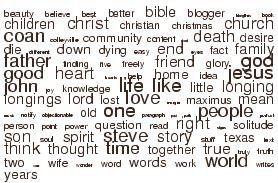
After 80 posts, here is how www.snapshirts.com condensed this blog. I wonder if someone could scan all the words and activities of my life and display it in a 3x2 square what that would look like.

Sunday, February 26, 2006

second nature

Sasha Cohen

I took the kids skating yesterday. It’s the first time I’ve been in…hmm…5 years? I was amazed at how it came right back, and in no time I was as good a skater as ever! (which in my case isn’t very good) But how easy it was to strap on those metal blades and hop on that slick ice and get to it. I can’t wait to go again. Next time out I’m going to attempt a triple lutz.

Skating, riding a bike, dancing, and all that—physical skills that we can train our bodies to do—isn't it amazing how they come right back somehow? Once we get the hang of it, it’s easy. Maybe it’s neural patterns that develop in our brain that just have to wake up and everything that was there last night is still there this morning. I wonder if the activities of our spiritual bodies are the same. I wonder if we learn to forgive if it becomes second nature to us. Or if we train ourselves to die to self, to become poor, to walk humbly, to be grateful or peaceable or kind or gentle or loyal or faithful. Do those patterns become a part of us forever? Is that part of living in this “way” Jesus talked about? Is that what he meant when he said it’s easy? Once we get the hang of it?

It would be a sick pun if it weren’t so beautiful, but Jesus did get the “hang” of godliness. And I think it was easy, even though painful, to just spend himself doing good and trusting God for the way it would turn out.

About the triple lutz—honestly, I doubt I will ever do one. On the other hand, I would be surprised if my daughter doesn’t someday. With only one lesson she’s already doing spins. The thing is it’s more important to her than it is to me. Which is why it’s worth it to her to spend her babysitting money and her time to get the hang of it.

Thursday, February 23, 2006

just did it

big swooshJesus never asked for permission to do good. He just did it. With a real recklessness I might add. All kinds of people mad at him all the time. Didn't know what to do with a guy who was so absolutely serious about doing good and so careless about being correct--politically, religiously socially, or otherwise. Wow. Didn't know what to do with a guy who really believed that there was a power in godliness. Didn't know what to do with a guy who didn't care what they thought or even what He thought, only what God thought. And just did it.

I wonder where we went astray.

Wednesday, February 22, 2006

do you want to be right or married?

On The Journey Towards Humility
written by JOE VORSTERMANS

In a session of marriage therapy, I was confronted with the question "Do you want to be right or do you want to be married?" I had asked questions like this before, but it had a very different feeling when it was directed at me! When I asked the question of others whom I was trying to help, it sounded so profound and made me feel so wise. When it was asked of me, I felt embarrassed, challenged and humbled...in that order.

I felt embarrassed for not "getting it" sooner. I was so self-righteous that I didn't recognize my arrogance. I'd placed so much value on being right and being able to articulate the problem as I saw it that I forgot that marriage is about loving the other, not correcting the other. Then I saw it as a challenge to grow. The counselor said to me, "Hold yourself in warm regard." I recognized that my self-righteousness was only part of me, a part I could become free of, if I so desired.

Those words, "Hold yourself in warm regard," helped me to recognize that I was on a journey towards wholeness, towards being a more loving husband, and that my desire to grow was more important than where I was on the journey. This realization allowed me to move from embarrassment to humility. My embarrassment made me want to run and hide. My humility made me more tender and encouraged my desire to be more accepting of my partner's failings as well as my own and to cherish the journey we are on together.

So this was my weekly update from Henri Nouwen this week. Good stuff. I love the question, “Do you want to be right or do you want to be married?” That’s a great question for a marriage counseling session. But it’s a much greater question for a follower of the Way, for the bride of Christ. “Do you want to be right or do you want to be married?” I think you have to choose.

Friday, February 10, 2006

dying well

I know a man who seemed to have it all together. And I respected him. And then I saw that man becoming more and more aware of his need for more of Jesus. And I was moved. And then I saw that man humbling himself and seeking God. And I experienced a certain awe. And then I saw that man completely broken by circumstances in his life. And I wept. And then I saw that man wait on God. And I was inspired. And then I saw that man beginning to be restored. And I rejoiced. And then I saw that man choose to live the rest of his life for others. And it settled my soul. Yesterday that man, in Sri Lanka building houses for tsunami victims, had a heart attack. And how am I supposed to feel?

I got Henri Nouwen's devotional today. It's called Dying Well. David will probably recover from this heart attack. But he won't live forever. Nor will any of us. So how should we live? How should we die? Here's what Nouwen wrote:

We will all die one day. That is one of the few things we can be sure of. But will we die well? That is less certain. Dying well means dying for others, making our lives fruitful for those we leave behind. The big question, therefore, is not "What can I still do in the years I have left to live?" but "How can I prepare myself for my death so that my life can continue to bear fruit in the generations that will follow me?"

Jesus died well because through dying he sent his Spirit of Love to his friends, who with that Holy Spirit could live better lives. Can we also send the Spirit of Love to our friends when we leave them? Or are we too worried about what we can still do? Dying can become our greatest gift if we prepare ourselves to die well.

What an awesome thought. Instead of living for retirement (saving our life), we can die for others. I wrote back in January about dying to live. Henri Nouwen wrote about living to die. The truly powerful in life are the ones who have reckoned with their own death, the ones who live as if their death is sure. But the one who has overcome the world is the one who doesn't live as if he will die, but rather as if he has already died.

It strikes me whether we are looking forward or looking back, the Way of life is only seen clearly through the window of death.

This song is resonating with me. It's in my heart and has found my voice. I admit to being a Christina Perry fan. I've been known to...